This is a copy of a presentation I made at a recent conference about open source, open content, and OER.
Open source tools and resources: what are they and what's out there?
Tuesday, November 20, 2012


Monday, October 15, 2012
On MOOCS
I'm back! It was an extremely hectic summer for me and my colleagues - getting our fall list ready to go - but things are settling down now, as we ramp up for the winter semester.
I've been following the ID news, and it seems that the mainstream press has discovered MOOCs!
I've seen a record number of articles in the past few weeks describing, praising and/or criticizing massive open online courses. Some prominent universities are adding courses to Coursera or edX. Udacity is quite popular, and even itunes is in the game!
Just to set the record straight, George Siemens and Stephen Downes, both Canadian, were among the first to offer and promote MOOCS. I've embedded a short video (narrated by Dave Cormier) that explains what a MOOC is and how it works:
source: YouTube: http://www.youtube.com/watch?feature=player_embedded&v=eW3gMGqcZQc#!
See more at: http://www.connectivistmoocs.org/what-is-a-connectivist-mooc/
I've been following the ID news, and it seems that the mainstream press has discovered MOOCs!
I've seen a record number of articles in the past few weeks describing, praising and/or criticizing massive open online courses. Some prominent universities are adding courses to Coursera or edX. Udacity is quite popular, and even itunes is in the game!
Just to set the record straight, George Siemens and Stephen Downes, both Canadian, were among the first to offer and promote MOOCS. I've embedded a short video (narrated by Dave Cormier) that explains what a MOOC is and how it works:
source: YouTube: http://www.youtube.com/watch?feature=player_embedded&v=eW3gMGqcZQc#!
See more at: http://www.connectivistmoocs.org/what-is-a-connectivist-mooc/
Friday, June 8, 2012
Plagiarism - how much of an issue is it in post-secondary institutions?

When we talk about plagiarism in post-secondary institutions, we're usually talking about students plagiarising: quoting without attribution, "lifting" sections of text from online publications, textbooks, or other materials, or simply referencing materials incorrectly. We can fix that with education. But what if the instructor or subject matter expert (SME) plagiarises? What can we do about that?
I think it's more than a matter of ethics - in many cases, I don't believe that SMEs realize that information found on the web can't be copied into their lesson plans without attribution - even if no copyright notice is visible.
The familiar © symbol means that all rights are reserved by the author, but for many of us, that restriction is too harsh (we want to share our creations!). Enter the Creative Commons. With a Creative Commons licence, we can determine how our works are used and distributed. Licences range from the least restrictive CC BY - which allows users to pretty much do as they wish with our works - so long as they cite us as the original author, to the most restrictive CC BY NC ND, which means users can download and share our work but not modify it.
Back to our dilemma with the SMEs. When instructors and SMEs worked only in brick and mortar classrooms, they commonly shared articles, newspapers and such with their classes. In a digital world, where such items have to be scanned or copied and posted to an online site, copyright concerns are far more visible. And it's not just text. Images and video may also be copy protected. Locating them through an online search does not guarantee that the items are 'free' for you to use. You have to ensure that every resource you find is correctly attributed and that the original owner has granted permission for you to use it.
A final thought: Many instructors use Youtube or TED videos to illustrate a point, or construct slide shows with lots of cool images, quotes and the like. Before you show that video remember to check that the author has given her permission and that you give proper credit. I recently saw a note in an online forum - students were chuckling about the fact that their instructor had just shown them a video about plagiarism; a video, it turns out, that the instructors didn't properly source or credit...
Wednesday, May 30, 2012
Friday, April 27, 2012
Implementing and evaluating your course
IN ADDIE, we call the final stages of course development the Implementation and Evaluation stages. In my model of course development, in the final two stages, I first determine if my expectations have been met, and review all my goals, actions, activities, resources, and expectations.


So how do I do that? First I have to ask myself: what are my expectations for this course? Way back in the beginning, I set the goals of this learning experience. A typical goal in corporate training is to improve performance, so my goal may be to "Increase sales by X% by the second quarter". In academia, the goal may be to "Apply instructional design principles to create pedagogically sound learning materials" (by the end of this course). The elements that each goal have in common? There is an action that must be completed to a specific standard within a specified time frame.
To determine if my expectations have been met, I review the rubrics I made for each activity. If I find that most of my learners performed poorly, I'll have to determine what went wrong.Were my goals too vague? Too stringent? Did I provide relevant job aids, practice exercises, and other resources? If not, why not?
I can't rely on just my opinion! At the conclusion of every period of instruction, we have to see what the learners thought of the instruction - and the instructors! (Remember, we also solicit this information throughout the course of study) The best way to survey learners and faculty is probably via an anonymous questionnaire. (hint: survey monkey is a great place to host an online survey). When we get the survey results we'll know which elements of the course worked and which didn't...and then we make the modifications and run through the cycle again. Remember, all developments are ongoing. Every time we run a course, we should always be looking at the experiences of our learners and instructors and make changes as required.
Monday, April 2, 2012
Creating learning activities
Last month I wrote about the first 2 elements of my learning model. Today I'm going to revisit the third element: Create, which focuses on creating activities that help learners practice their actions, and Provide, which focuses on providing resources to help learners complete the activity.

Envision the following scenario: the objective is to help the learners develop good presentation skills. It's an online class, so they will use your web conferencing platform to deliver a short presentation on a topic of their choice. They can use the the whiteboard app, application sharing or web tour, whichever they like. They have 5 minutes to present.
My preparation: I've shown the learners a number of online presentations, both good and not so good. We've discussed what makes a good presentation and pitfalls to avoid. I've also begun to prepare a rubric that they can use to help them prepare their presentation - reproduced below. As part of their preparation, each group will add the remaining criteria to this rubric. When all groups have finished this task, we'll get together for a discussion.

When the rubric is finished the learners will use it as an aid to help them polish their presentations. When the presentations are finished, the students and the instructor will use the rubric to score and comment upon the presentations. We'll have a number of sessions like this one, finally reaching the point where each learner creates and delivers a 20 minute presentation online.
Next time, we'll talk about the last 2 elements of my model:


Envision the following scenario: the objective is to help the learners develop good presentation skills. It's an online class, so they will use your web conferencing platform to deliver a short presentation on a topic of their choice. They can use the the whiteboard app, application sharing or web tour, whichever they like. They have 5 minutes to present.
My preparation: I've shown the learners a number of online presentations, both good and not so good. We've discussed what makes a good presentation and pitfalls to avoid. I've also begun to prepare a rubric that they can use to help them prepare their presentation - reproduced below. As part of their preparation, each group will add the remaining criteria to this rubric. When all groups have finished this task, we'll get together for a discussion.
When the rubric is finished the learners will use it as an aid to help them polish their presentations. When the presentations are finished, the students and the instructor will use the rubric to score and comment upon the presentations. We'll have a number of sessions like this one, finally reaching the point where each learner creates and delivers a 20 minute presentation online.
Next time, we'll talk about the last 2 elements of my model:

Thursday, March 1, 2012
Content alone will not be enough to engage your learners. !Ever!
I read an article recently in which the author chronicled his transformation from lecturer to facilitator of peer instruction (Don’t Lecture Me: Rethinking How College Students Learn). I, of course, thought about his comments in regard to e-learning. How often do we see instructional designers create lessons that ask our learners to passively absorb information through reading or listening? Basically, we've taken the f-2-f lecture format and made it even more passive and - shall I say it? - uninspiring - than the lecture from which it was derived!
Many instructional designers begin and end with the content delivered by the SME, which is highly focused on what the learner needs to know by the end of the instructional period. What we really need to do is use that content to decide what the learner needs to DO by the end of the instruction. Not long ago, I created a graphic and posted it here in the blog. The graphic, part of which is repeated below, tells us to first, define the goal of this learning, then identify the actions learners can take to reach the goal.
 It's not enough to focus our efforts on getting the content complete and correct. We have to create opportunities for the learners to apply the information contained within the course to solve something - whether it be how to solve a math problem or how to conduct an interview.
I work for a college, so I'm all about applied learning. Come to think of it, I'd be about applied learning if I worked for a university! I believe that focusing on content leaves a very large gap between the passive transfer of information in an educational environment and learners' performances in the real world, doing real world tasks.
My final word (for now):
Content alone will not be enough to engage your learners. !Ever!
More on this next post.
Many instructional designers begin and end with the content delivered by the SME, which is highly focused on what the learner needs to know by the end of the instructional period. What we really need to do is use that content to decide what the learner needs to DO by the end of the instruction. Not long ago, I created a graphic and posted it here in the blog. The graphic, part of which is repeated below, tells us to first, define the goal of this learning, then identify the actions learners can take to reach the goal.

I work for a college, so I'm all about applied learning. Come to think of it, I'd be about applied learning if I worked for a university! I believe that focusing on content leaves a very large gap between the passive transfer of information in an educational environment and learners' performances in the real world, doing real world tasks.
My final word (for now):
Content alone will not be enough to engage your learners. !Ever!
More on this next post.
Wednesday, February 1, 2012
Designing learning for today's learners
A few days ago, I found an image that depicted the many ways educators can use ICT to engage and challenge their learners. I decided to create a similar graphic, but I used images of people interacting with various technologies instead of the spheres in the original. This is the image I created:

Are you keeping up? If you're teaching face-to-face, do you show YouTube videos in class? Do you ask your learners to collaboratively solve a problem using a smart-board? Do you exchange texts or bring in guest speakers via video conferencing? Elicit comments through clickers or smartphones? If you're not doing all or most of the above, you should be. In but a few more years, what we now consider blended learning (classroom based + ICT) will become the standard. Today's learners want to be educated using the tools they use every day. Learners have become consumers of educational goods - if we don't supply them with the tools and experiences they're looking for - they'll simply take their business elsewhere.
If you teach online, are you using the technologies available to you? Do you use web conferencing in a collaborative way, or are you replicating the sage on the stage electronically? In one of our portfolio classes, we ask the students to create an electronic portfolio, then present it to their classmates and the instructor live through our web conferencing platform. If you're on a smaller budget, you can accomplish the same thing with Skype. Social media sites are a great place to post lesson plans and assignments. Twitter is a great way to keep in touch. No longer should interactions in an online class be relegated to the (asynchronous) discussion forum or course email. Use the technologies available to you to reach out and interact with your learners - in a way that they're accustomed to.
(Or you'll lose them)

Are you keeping up? If you're teaching face-to-face, do you show YouTube videos in class? Do you ask your learners to collaboratively solve a problem using a smart-board? Do you exchange texts or bring in guest speakers via video conferencing? Elicit comments through clickers or smartphones? If you're not doing all or most of the above, you should be. In but a few more years, what we now consider blended learning (classroom based + ICT) will become the standard. Today's learners want to be educated using the tools they use every day. Learners have become consumers of educational goods - if we don't supply them with the tools and experiences they're looking for - they'll simply take their business elsewhere.
If you teach online, are you using the technologies available to you? Do you use web conferencing in a collaborative way, or are you replicating the sage on the stage electronically? In one of our portfolio classes, we ask the students to create an electronic portfolio, then present it to their classmates and the instructor live through our web conferencing platform. If you're on a smaller budget, you can accomplish the same thing with Skype. Social media sites are a great place to post lesson plans and assignments. Twitter is a great way to keep in touch. No longer should interactions in an online class be relegated to the (asynchronous) discussion forum or course email. Use the technologies available to you to reach out and interact with your learners - in a way that they're accustomed to.
(Or you'll lose them)
Wednesday, January 18, 2012
ADDIE Interactive!
I only had a few spare minutes, so I decided to create a quick and dirty demo of an interactive application to match 7 definitions to the phases of ADDIE to which they belong.The following is a Screenr presentation that shows a user (me) interacting with the app. Sorry, no audio! The app is built with Dreamweaver's Coursebuilder.
Wednesday, November 30, 2011
Focusing on activities
Why do so many online courses focus on content? If your
learners have a text book, why do so many instructional designers feel they
have to replicate the text in the online course? What does this accomplish?
Well, I’ve been pondering those questions for years – and asking
my colleagues to focus on creating activities to support the learning
objectives rather than paraphrase the text. It’s more difficult, it takes
longer…and it can lead to an excellent learning experience…
So how do we create activities not content? Some
instructional designers argue that because they are not content experts, they
can’t be expected to be able to determine what the learners need to know at the
end of a lesson. Well, I do a lot of developing sans content expert, and here’s
what I’ve discovered: if I have a good learning objective, I can design
activities to support that objective. If the objective is a simple “Describe…. “
(I hate those) I can have the learners search out descriptions on the web, in their text, or through conversations with
others. Better yet, I can give them the descriptions and ask them to match them
to terms using a simple interactive application. Ever play My Word Coach for
the DS or Wii? One of the quizzes in that program does just that – except you’re
racing against the clock. As you proceed through the levels, the terms and
definitions keep coming back to you in various games, and at the end of each
level you’re almost certain to have a far better understanding of the term than
you did at the start of the instruction.
Instead of providing content, I provided an interactive
activity that my learners would enjoy – and that would help them learn and
understand the terms they need to be able to go on to the next activity. Next
post, I’m going to tell you how and why I designed that activity.
Tuesday, November 1, 2011
HOTS (Or Bloom, Part II)
In my previous post, I told you about designing learning activities for a group of students learning group counselling skills. The plan was to have them collect (and remember) information, understand it, and apply it (by leading the group). Sometimes, we need to move the learners past apply and on to analyzing, evaluating, and creating new meanings. In the case of our soon-to-be counsellors, we've already begun to push them toward the acquisition of higher order thinking skills.
After our learners took turns leading the group, we had them discuss their experiences. This gave them a chance to analyze their behavior as group leader - and to receive advice and opinions from their peers. We asked them to evaluate both their own performance and the performance of the others in the team.
Create is the highest level in the modified taxonomy. What we're eventually going to do with our counselling students is have them put together everything they've learned in this module to create their own facilitation plan for a group meeting with their clients.
After our learners took turns leading the group, we had them discuss their experiences. This gave them a chance to analyze their behavior as group leader - and to receive advice and opinions from their peers. We asked them to evaluate both their own performance and the performance of the others in the team.
Create is the highest level in the modified taxonomy. What we're eventually going to do with our counselling students is have them put together everything they've learned in this module to create their own facilitation plan for a group meeting with their clients.
Monday, October 31, 2011
Let Bloom guide your learning design
When I design a course, I start by trying to get a feel for the prospective learners. Who are they? What do they expect from this course? What do they already know? Then I start thinking about how to design learning suited to their needs - learning that's interesting, effective, and on point.
If the learners are new to the subject matter, I'll start by getting them to discover pertinent information about the topic. This is the lowest level of Bloom's Taxonomy; before you can understand or apply a concept or theory, you first have to possess the information, and work at finding ways to understand it. Bloom called this lowest level Knowledge, but most of us now use the updated term 'Remember'. The images below document the changes, the biggest of which is a change from using nouns to verbs to describe the levels:


Traditionally, educators - from K12 to post-secondary - presented information to learners through lectures or reading assignments. I find those methods a bit too static, and truth be told, boring! I flash back to my undergraduate days, when my economics prof used to read to us - from the book - in the dullest of monotones. I swore I'd never do that to my learners.
So how can we design learning that will get the required information to the learners without boring them silly? Well, one thing we can get them to do is to search out the information themselves, using the net, the school library, family, friends, magazines, videos, books...whichever way works best for them. When they've gathered the information, get them to discuss it. If this is a F2F class, use a discussion circle, a buddy system, or small groups. If you're in an online class, use the discussion board - or - better, use your web conferencing system to hold a group discussion. In either case, you can have your learners create videos, slide shows, or audio to help them present their findings. As they gather and subequently discuss and present their findings, they will have a much better understanding of it, which is the second level of Bloom's Taxonomy.
The third level of Bloom is Apply. We can't apply information until we've gathered it, remember it, and understand it. Take the case of a group of students learning group counsellimg skills (this is from a course I'm working on). First, I have the students find information related to group management, facilitation strategies, team dynamics, personalities, etc. Then they discuss what they've found and come to an understanding of what they need to know to become effective counsellors. The information is no good to them in a vacuum. They need to apply it. What better way than to lead a group? After they've each led the group, they'll get feedback from the course facilitator and the other group members.
FYI, years ago, when I took a 'train the trainer' type course, the facilitator took a video of each of us as we presented so we would be able to see how we looked and sounded. It was a great learning tool.
The next three stages of the taxonomy focus on analyzing, evaluating, and creating. Next post we'll concentrate on these HOTS - higher order thinking skills.
If the learners are new to the subject matter, I'll start by getting them to discover pertinent information about the topic. This is the lowest level of Bloom's Taxonomy; before you can understand or apply a concept or theory, you first have to possess the information, and work at finding ways to understand it. Bloom called this lowest level Knowledge, but most of us now use the updated term 'Remember'. The images below document the changes, the biggest of which is a change from using nouns to verbs to describe the levels:


So how can we design learning that will get the required information to the learners without boring them silly? Well, one thing we can get them to do is to search out the information themselves, using the net, the school library, family, friends, magazines, videos, books...whichever way works best for them. When they've gathered the information, get them to discuss it. If this is a F2F class, use a discussion circle, a buddy system, or small groups. If you're in an online class, use the discussion board - or - better, use your web conferencing system to hold a group discussion. In either case, you can have your learners create videos, slide shows, or audio to help them present their findings. As they gather and subequently discuss and present their findings, they will have a much better understanding of it, which is the second level of Bloom's Taxonomy.
The third level of Bloom is Apply. We can't apply information until we've gathered it, remember it, and understand it. Take the case of a group of students learning group counsellimg skills (this is from a course I'm working on). First, I have the students find information related to group management, facilitation strategies, team dynamics, personalities, etc. Then they discuss what they've found and come to an understanding of what they need to know to become effective counsellors. The information is no good to them in a vacuum. They need to apply it. What better way than to lead a group? After they've each led the group, they'll get feedback from the course facilitator and the other group members.
FYI, years ago, when I took a 'train the trainer' type course, the facilitator took a video of each of us as we presented so we would be able to see how we looked and sounded. It was a great learning tool.
The next three stages of the taxonomy focus on analyzing, evaluating, and creating. Next post we'll concentrate on these HOTS - higher order thinking skills.
Tuesday, October 25, 2011
Pushing a scenario to help college students with interview skills
Recently, I was working on a course to prepare college students for life after graduation. You know the drill: resume preparation, job search skills, interview etiquette - the whole nine yards. As online courses go, it's pretty good. We provided lots of opportunities for the students to interact with the materials, the facilitator, and each other. We had them post to the discussion board, prepare an electronic portfolio, and present the portfolio to the group through a web conferencing session.
I sit here today trying to figure out how we could have done it better. For all our efforts, we were still pushing the bulk of the learning materials to the students. How could we get them to pull the information instead? And then it clicked. A scenario could pull all of this together!
I quickly mapped out the beginnings of a scenario in PowerPoint 2010, as seen below:


This is a simple hyper-linking procedure in PowerPoint 2010. In the first slide, choosing Google brings the user to slide two, and explains why the choice is incorrect. If the user answers FaceBook, they are brought to Slide four, which is also incorrect.. If the user picks either of these incorrect answer choices they will not be able to proceed. The company's website answer is the correct option, so that option brings the user to the next challenge slide.
The next challenge presents the student with two choices to prepare for the interview:


The third challenge is the interview itself. I'm not going to show you all the slides, but the scenario is this: you reach the interview room, meet the interviewer, and exchange greetings. After that, the interviewer asks your avatar (Lara, in this case) to tell her about herself.


The next few challenges ask you to answer some standard interview questions. After those are completed, you'll be taken to another slide that provides even more resources for you to examine. How is this better than pushing content? I believe that giving the student the flexibility to choose different responses - and providing feedback - will help them to see how the interview process might function in real life.
After the presentation is complete, I'll convert it to flash and post it.
I sit here today trying to figure out how we could have done it better. For all our efforts, we were still pushing the bulk of the learning materials to the students. How could we get them to pull the information instead? And then it clicked. A scenario could pull all of this together!
I quickly mapped out the beginnings of a scenario in PowerPoint 2010, as seen below:


This is a simple hyper-linking procedure in PowerPoint 2010. In the first slide, choosing Google brings the user to slide two, and explains why the choice is incorrect. If the user answers FaceBook, they are brought to Slide four, which is also incorrect.. If the user picks either of these incorrect answer choices they will not be able to proceed. The company's website answer is the correct option, so that option brings the user to the next challenge slide.
The next challenge presents the student with two choices to prepare for the interview:


The third challenge is the interview itself. I'm not going to show you all the slides, but the scenario is this: you reach the interview room, meet the interviewer, and exchange greetings. After that, the interviewer asks your avatar (Lara, in this case) to tell her about herself.


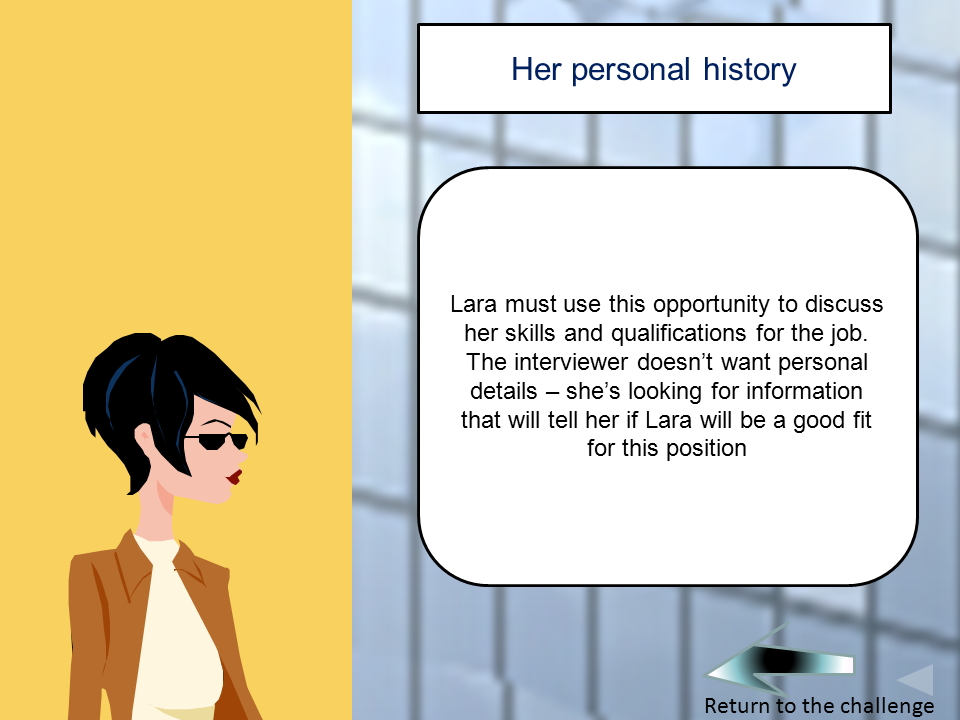
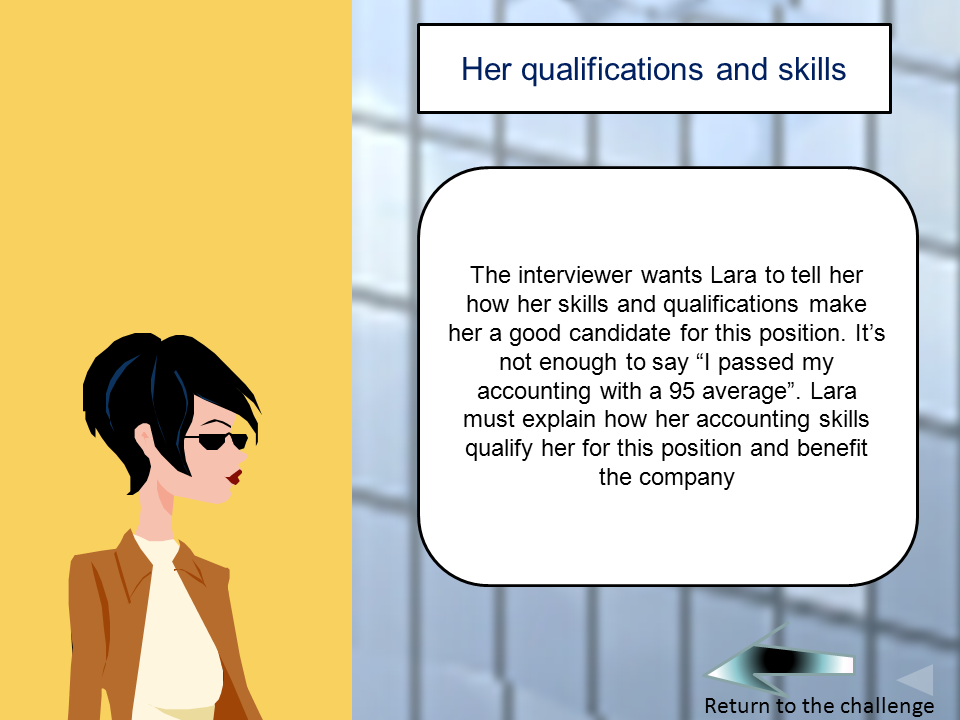

The next few challenges ask you to answer some standard interview questions. After those are completed, you'll be taken to another slide that provides even more resources for you to examine. How is this better than pushing content? I believe that giving the student the flexibility to choose different responses - and providing feedback - will help them to see how the interview process might function in real life.
After the presentation is complete, I'll convert it to flash and post it.
Monday, October 17, 2011
The Sage on the Stage vs the Guide on the Side!


The ‘Sage on the Stage’ method of teaching uses direct instruction to transmit knowledge. In other words, a teacher shares his or her knowledge with the class by delivering lectures, or, in the online world, by delivering content. The learners are expected to passively absorb the information and regurgitate it at another time, usually by answering multiple choice questions.
In contrast, the ‘Guide on the Side’ facilitates discussion, collaboration, and interaction. Learners are expected to interact with the materials and each other, adding new information to prior learning to build new knowledge. A couple of years ago I was at an instructional design conference where the facilitator gave a 2 hour lecture on learning theories. At the end of the lecture, many of the participants were still in the dark about the relevance of learning theories to their work developing and designing course ware.
How would I explain the importance of learning theories to course development? Well, I’d get the audience to participate by asking questions, as in this example:
You’re going to teach someone to type. What would you do: (A) have the learners discuss the best way to tackle the problem (B) Show them a similar activity and then ask them to apply it to typing (C) Put them in front of a keyboard and give them practice activities.
A is constructivist, B is cognitivist, and C is behaviorist.
In this case, “C” seems like the right approach, doesn’t it? We learn to type through practice and repetition. Behaviorist approaches to learning look for a change in behaviour; in this case, from unskilled to expert. Think of other areas where a behaviorist approach to learning makes sense. Here’s one of mine: Skilled trades, i.e. welder. All welders must learn similar skills, methods, and procedures. Learning strategies based on behaviorism focus on promoting retention of basic facts, skills or procedures. Most IDs wouldn’t use a behaviorist strategy if they were trying to promote higher order thinking.
How about if you were teaching an advanced programming class? It’s not so much about repetition as it is about processing new information - in the light of prior learning - to create new learning. So if I know how to write a program in Java, I can build on that knowledge to create a program in a new language. My program may have different routines than yours, but we each achieve similar results. Cognitivist learning strategies are best used where you want your learners to reason, problem-solve, or process information.
In graduate school, we talked…a lot. We debated, discussed, and argued all the time. We learned from those discussions. Constructivist theories promote just this sort of collaboration and debate, because of the belief that all knowledge is constructed, collaborative, and social. It’s not independent; it’s created through our own interpretations and experiences. Constructivist theories also promote higher level thinking, problem-solving, and collaboration, but the focus is on group work and the construction of shared meanings.
This all sounds pretty straight-forward, doesn’t it? But here’s the catch: You first have to have the foundation before you can build on it. After you’ve learned the basics of your trade or profession, you can use that knowledge to build new knowledge. For adults, we do seem to learn best in a collaborative environment. We certainly like to be involved in our learning, and most of us see little value in passively waiting for the ‘Sage’ to share their knowledge with us.
Sunday, October 16, 2011
Push vs Pull
Get your learners to pull the course content rather than you pushing it out to them
In typical online courses, instructional designers and subject matter experts ‘push’ information to their learners through readings and quizzes. In some cases, that may be the right way to get the information out there - but it won’t necessarily help your learners tackle real world problems, develop their thinking skills, or hone their analytical abilities.
Using a scenario can be a great way to get your learners to ‘pull’ the information they need to solve a problem. Here’s how to start:
Before you write a word, stop and think about the result you’re looking for: what exactly do you want your learners to know how to do when they complete this training? And, just as importantly, how are you going to know if they’ve met your expectations? Next, you need to connect the information to your learners. Who are they? Why are they taking your course? Are they just beginning to learn about this subject, or do they already have a good foundation? And finally, ask if they’re media savvy – I once built a course heavily dependent on technology use, then found out the participants were barely computer literate. Know your audience!
When you start writing your content, remember to have the learners DO something with the information you’re feeding them. Scenarios allow them to make decisions and use their understanding to transfer the information to other settings. It also makes the learning more meaningful to them and makes it more likely to ‘stick’. For a twist, give them no information up front. Let them uncover the information as they tackle the scenario. This is a great way to test their assumptions (and yours) and see where they’re really at. Remember to give them lots of opportunities to research and uncover the information they’ll need to successfully complete the scenario. Remember too, that feedback – formative feedback – is crucial. Above all, ensure that your scenarios are accurate, realistic, and factual.
Friday, October 29, 2010
Jane Hart's Top 100 learning tools
The top 10 learning tools for 2010 are:
* Twitter
* YouTube
* Google Docs
* Delicious
* Slideshare
* Skype
* Google Reader,RSS / Feed reader
* Wordpress
* Facebook,
* Moodle
Visit Jane Hart's Centre for Learning & Performance Technologies for the full top 100.
* YouTube
* Google Docs
* Delicious
* Slideshare
* Skype
* Google Reader,RSS / Feed reader
* Wordpress
* Facebook,
* Moodle
Visit Jane Hart's Centre for Learning & Performance Technologies for the full top 100.
Monday, May 17, 2010
Some of my favourite bloggers
To keep up-to-date on what's new in the online learning world, try these three sites:
Stephen Downes.
Stephen writes about online learning, content syndication, and new media.
Terry Anderson
Terry writes about the use of social software in distance education, among other topics, in his blog.
George Siemens on connectivism
For creative help in designing rapid, effective learning - check out these blogs:
The Rapid E-learning Blog
Lots of design ideas and tips for creating interesting content
Cathy Moore's Blog
More design ideas and tips
Clive on e-learning
Clive has lots of interesting things to say about e-learning
Thursday, January 14, 2010
The Horizon Report 2010
Just reading the Horizon report (Johnson, L., Levine, A., Smith, R., & Stone, S. (2010). The 2010 Horizon Report.Austin, Texas: The New Media Consortium.)...
Some interesting links to mobile learning projects at various universities, including University of Waterloo. Almost everyone has a mobile device and many will take advantage of it to review course work while commuting, waiting for appointments, etc. or to communicate with profs and fellow students. U Waterloo found that students reported spending more time accessing course materials and collaborating with their classmates when materials were delivered to their blackberries. E-books were also mentioned as a boon for students, as they could carry an entire course load of readings and textbooks with them and read as time permits.
The report also mentioned the increased availability of open educational resources, commenting that " students are learning not only the material, but also skills related to finding, evaluating, interpreting, and repurposing the resources they are studying in partnership with their teachers. "
More later...
Some interesting links to mobile learning projects at various universities, including University of Waterloo. Almost everyone has a mobile device and many will take advantage of it to review course work while commuting, waiting for appointments, etc. or to communicate with profs and fellow students. U Waterloo found that students reported spending more time accessing course materials and collaborating with their classmates when materials were delivered to their blackberries. E-books were also mentioned as a boon for students, as they could carry an entire course load of readings and textbooks with them and read as time permits.
The report also mentioned the increased availability of open educational resources, commenting that " students are learning not only the material, but also skills related to finding, evaluating, interpreting, and repurposing the resources they are studying in partnership with their teachers. "
More later...
Friday, December 18, 2009
Sixth sense

http://blog.ted.com/2009/03/sixth_sense_demo.php
This video from TED shows ‘Sixth sense’, a hardware/software program under development at MIT. It's a wearable device with a projection screen that lets the user interact with the environment. This screen shot shows the inventor interacting with a telephone projected onto his hand! Cool. very cool!
Friday, October 30, 2009
using wikis for research
interesting video on using wikis for qualitative research
http://sabri4e-learning.blogspot.com/2009/10/using-wikis-to-conduct-qualitative.html
http://sabri4e-learning.blogspot.com/2009/10/using-wikis-to-conduct-qualitative.html
Subscribe to:
Posts (Atom)